Data Center Standards
Global Open Standards for Modern Data Centers in the Age of AI
Establishing holistic and dynamic open standards that address the evolving and modern requirements of AI factories, cloud infrastructure, and enterprise data centers
Global Standardization
AE360®, as a holistic global standards framework, presents an approach to assessing the operational risk and optimizing performance of data centers, cloud and AI infrastructure to fulfill the needs the Application Ecosystem®. This standards framework can be applied to individual or multiple data centers supporting one or more application ecosystems. This standards framework defines the grading methodology used to evaluate infrastructure performance and operational risk.
DownloadTechnical Standards Committee
The IDCA Technical Standards Committee is represented by some of the world’s leading digital infrastructure experts. The Committee’s mission is to advance the data center industry by addressing the standardization and compliance gaps and developing next-generation standards based on the the Infinity Paradigm®️ standards framework. It identifies new areas for standards development and works closely with key stakeholders, including operators, providers, investors, and end-users, to ensure effective standardization and compliance across the industry. The Committee is composed of experts selected from a wide range of industries and diverse backgrounds.

Download The Infinity Paradigm® AE360® 2.0
The all-in-one data center standards framework for diverse logical and physical infrastructure, and operation of complex application delivery stacks in the age of AI.
Testimonials
Leaving a Footprint of Passion for Excellence
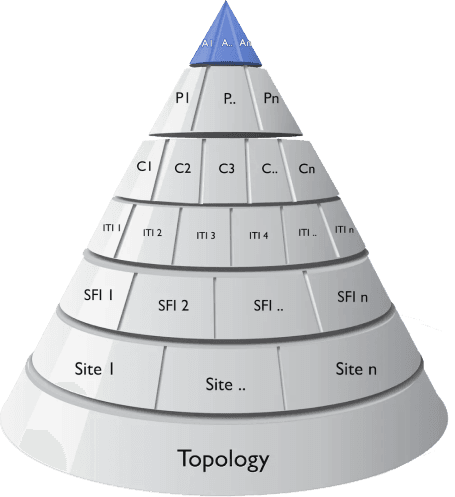
The 7 Stack Layers
The application exists and fulfills its purpose through the support of a holistic and vibrant ecosystem of interdependent logical & physical infrastructure and operating practices that sustain it.
- Application Architecture
- Application Availability
- Application Security
- Application Integrity
- Application Efficiency
- Inputs, Processing, and Outputs
- General Controls
- Application Reliability and Performance
- Application Capacity and Maintainability
- Business Specific Metrics
Standards Features
International Data Center Authority's mission is to establish the selection, design, implementation, and operational guidelines, based on learned lessons of the past, realities of the present, and the future ahead. IDCA standards carefully select the best and most effective practices and address key challenges with exceptional insight. This effort is tailored to serve comprehensive levels of information technology and data center requirements, catering to all industry sectors and verticals. IDCA is dedicated to integrating the global knowledge base for the mission-critical cloud, data center, application, information technology methodologies, parameters, systems, tools, and technologies, to ensure that the standards effectively address the challenges of the modern era.

Comprehensive
The Infinity Paradigm® was founded based on bridging existing industry gaps. It enforces a comprehensive view of the logical and physical aspects of information technology, data centers, and cloud, as well as their investments, designs, infrastructure, personnel, performance metrics, overall operations, and management.

Effective

Global

AI

Cloud
Grading & Scoring System
For AI, Cloud, IT, Application, and Data Center Grading System
Grade Levels, or “Gs®” are the method of performance classification within the various Application Ecosystem® layers. Gs® range from G4® to G0®, with G4® representing the minimum acceptable level of design, infrastructure, and operational vulnerabilities, such as probability of failure, security risks, inefficiencies, operational lags, capacity insufficiencies, and lack of resilience, while G0® essentially mandates total elimination of all such vulnerabilities. While G1® represents the highest achievable grade for a DCN comprised of ITI, SFI and Site, physically located in a single location, G0® represents ecosystem-level resilience achieved through embedded redundancies and functions at the Logical Layers of Application, Platform and Compute, as well as the Topology Layer.


Grade Level 0
Grade Level 0 (G0®) is the highest level of achievement but can only be attained by an Application Ecosystem®, and individually at the Application, Platform, Compute, and Topology layers. It signifies the absolute minimum levels of risk, insecurities, inefficiencies, vulnerabilities, and chances of failure across the interconnected ecosystem.

Grade Level 1
Grade Level 1 (G1®) is an exceptional level of achievement when awarded to any Application, Platform, Compute, ITI, SFI, Site, or Topology layers. It also represents the lowest levels of risk, insecurities, inefficiencies, vulnerabilities, and chances of failure that can be achieved within a single Data Center Node (DCN). G1® is therefore the highest attainable Grade Level a Data Center Node can achieve.

Grade Level 2
Grade Level 2 (G2®) is an excellent level of achievement when awarded to any Application, Platform, Compute, ITI, SFI, Site or Topology layers. G2® represents a low exposure to risks, insecurities, inefficiencies, vulnerabilities, and chances of failure.

Grade Level 3
Grade Level 3 (G3®) is the average level of achievement when awarded to any Application, Platform, Compute, ITI, SFI, Site or Topology layers. G3® represents an average exposure to risks, insecurities, inefficiencies, vulnerabilities, and chances of failure.

Grade Level 4
Grade Level 4 (G4®) is the lowest level of achievement when awarded to any Application, Platform, Compute, ITI, SFI, Site, or Topology layers. G4® represents the highest allowable levels of risk, the highest acceptable level of insecurities, inefficiencies, vulnerabilities, and chances of failure.
Efficacy Score Rating (ESR®)
The Efficacy Score Rating (ESR®) is the aggregated scoring metric used to evaluate Application Ecosystem® performance for evaluating and comparing the performance of a system, design, service, AE layer or the entirety of the AE. It is an aggregated value derived from an algorithmic evaluation of the results of each layer’s Grade Level performance, as well as the results of each efficacy. This scoring methodology takes into account the inherent effect of interdependencies across designs, policies, components, services, and layers and efficacies where it applies weightings to favor functions that are more central to supporting the AE.

Contribute. Adopt. Give Back.
IDCA promotes collaborative efforts and enables workgroups and organizations to work closely by taking part in IDCA’s global mission to develop highly comprehensive and effective application-centric standards that cater to data centers, infrastructures, information technology, cloud, AI, and applications. By taking part in this collaborative standardization, which is the first of its kind in the data center industry, one will be amazed at how the wide array of expertise from diverse backgrounds can result in such a comprehensive standard and well-informed user community. No matter how great or small your participation may be, it takes three simple steps to become a part of the development and continuous refinement of the greatest standards framework our industry has ever known.
Get Involved
Learn
Join the world’s elite. Observe and learn the latest industry trends, best practices, the Infinity Paradigm® insights, and become fully knowledgeable of the entire Application Ecosystem (AE)®.
Collaborate
Put your know-how into action. Push yourself to the limits of thinking outside the box. Collaborate with other industry experts, give inputs and take feedback. Be part of the future in the making.
Share
Contribute to the world. Be part of the movement that shares its gains with the industry, the community, and the world, for a better, more reliable, sustainable, ethical, and inclusive world.